Mobile shooters have come a long way since their tentative early days, evolving into one of the most lucrative and fiercely competitive segments on app stores. In 2026, looking back at a pivotal analysis originally published by GameRefinery in 2020, industry observers note how its core insights not only mapped the genre's past but also charted a trajectory that still defines the market today. The Finnish analytics specialist, now backed by even richer data sets after acquiring market insight firm Reflection.io, had pioneered a three-layered categorization that brought clarity to a once-chaotic field.

GameRefinery structured its taxonomy by first placing a title in a broad Category, then narrowing down to Genre, and finally specifying a Subgenre. For shooters, that meant distinguishing Battle Royale, Classic FPS/TPS, Snipers, and Tactical Shooter experiences. This layered lens proved essential for understanding why some titles soared while others stagnated. The approach enabled developers and investors to see how each subgenre catered to distinct player motivations, from the adrenaline highs of last-man-standing modes to the precision of sniper duels.
The report's retrospective value in 2026 cannot be overstated. It documented a turning point when the industry overcame two towering obstacles: awkward touchscreen controls and the skepticism of a PC/console-first shooter audience. Back then, titles like Call of Duty: Mobile had just demonstrated that a fluid, responsive interface could win over hardcore fans. Now, as we scroll through current top-grossing charts, that lesson is embedded in every successful release. Haptic feedback, gyro aiming, and customizable HUDs are no longer innovations; they are baseline expectations, a direct legacy of those early breakthroughs.
Despite the genre's fame, the shooter space was never overcrowded. In the US iOS market during 2020 Q2, only eight shooter titles ranked in the top-grossing 200. Yet those few titles punched far above their weight, capturing roughly 10% of all US iOS game revenue. That concentration of revenue remains a defining characteristic in 2026, where a handful of live-service behemoths continue to dominate, while the barrier to entry for new mid-core shooters keeps rising.
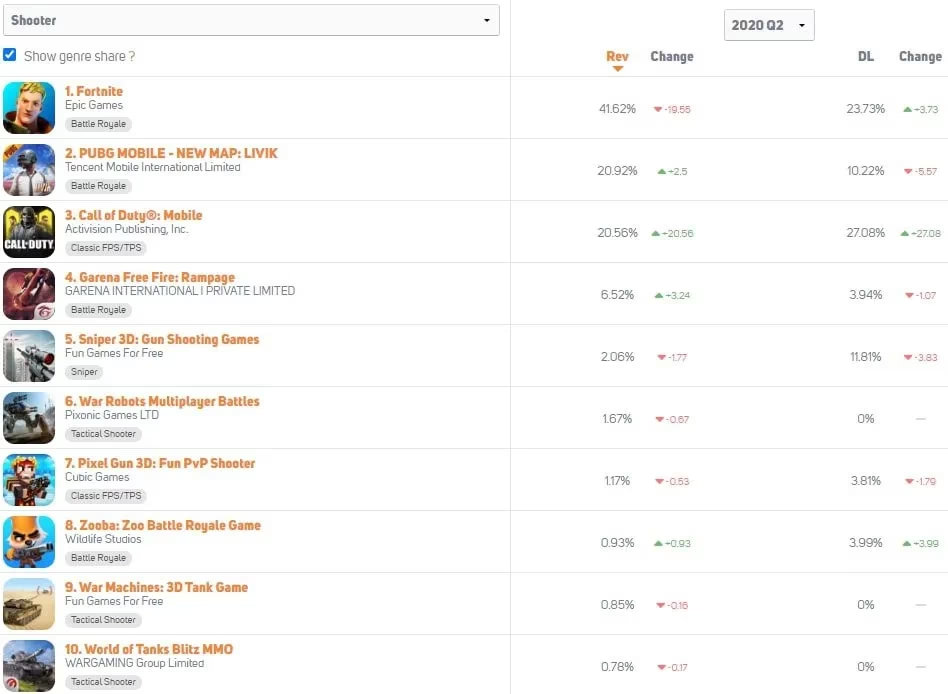
Looking at the 2020 leaderboard provides a striking historical snapshot. Fortnite, built by Epic Games, commanded a 41.6% revenue share among top shooter games, followed by PUBG Mobile with roughly 21%, and Call of Duty: Mobile at 20%. Even then, the report flagged Fortnite's shrinking slice of the pie, foreshadowing the seismic event that would shortly follow: Epic's breach of app store payment policies and the subsequent removal of Fortnite from both Apple's App Store and Google Play. While Epic fought legal battles and eventually launched its own mobile storefront years later, the episode became a case study in platform dependency, a topic still referenced in boardrooms today.
Another striking finding was the age of top shooters. More than 75% of the top-grossing 200 shooter games were over two years old. This longevity, which has only intensified in 2026, underscores the power of live operations. Shooter audiences do not simply chase the next new thing; they invest deeply in ecosystems, Battle Passes, and seasons. GameRefinery emphasized how Battle Pass and decorative item monetization work exceptionally well in shooters precisely because they avoid pay-to-win pitfalls. Cosmetics, weapon skins, and emotes feed player expression without fracturing competitive integrity—a model refined over years and now standard across the entire mid-core landscape.
The report mapped the genre's evolution through three distinct waves, a framework that remains a useful lens for understanding subsequent developments. The First Wave was populated by sniper and tactical shooter games, titles that filtered into the top-grossing charts without massive mainstream buzz. These experiences proved that a focused, skill-based loop could attract a paying audience. The Second Wave arrived with the battle royale explosion. Fortnite, PUBG Mobile, and Garena Free Fire did not just dominate revenue—they reshaped gaming culture, introducing larger map sizes, 100-player matches, and the iconic shrinking circle. They also brought with them social features and spectacle that made mobile gaming a spectator sport.
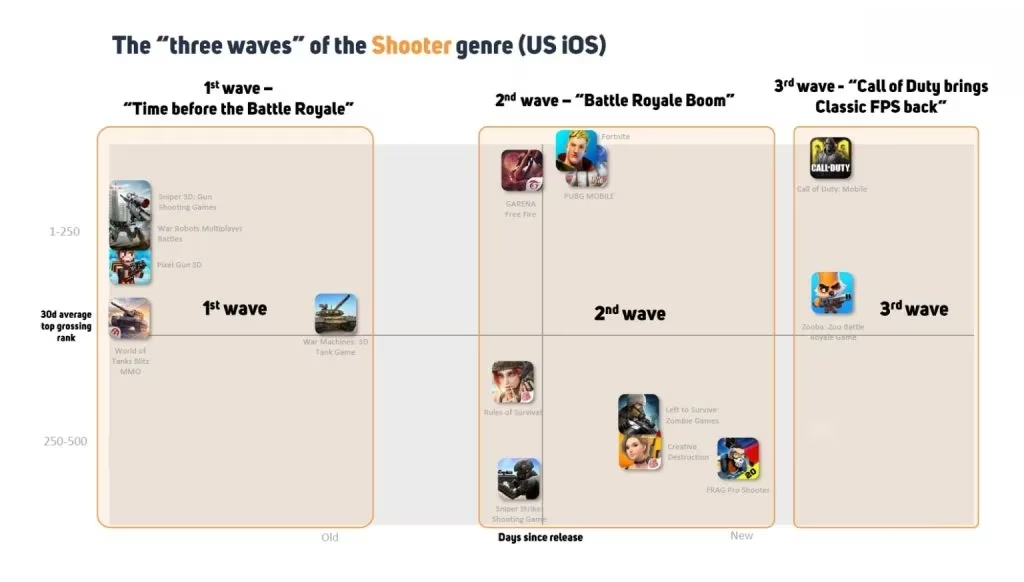
The Third Wave was heralded by Call of Duty: Mobile, a Classic FPS that proved the appetite for traditional team-based modes like Search & Destroy and Domination extended far beyond consoles. In 2026, analysts frequently debate what constitutes the Fourth Wave. Many point to the rise of extraction shooters, genre-hybrid titles blending RPG progression with high-stakes raid mechanics. Others highlight advanced user-generated content tools that let mobile players build custom maps and modes, echoing the sandbox spirit of Roblox but with military-grade mechanics. Whatever the case, the waves model keeps reminding us that innovation in the shooter space is cyclical, each new hit building on the shoulders of its predecessors.
For developers eyeing the genre in 2026, the GameRefinery insights still hold valuable warnings and encouragements. The space is not saturated, but breaking in demands more than just polished gunplay. A new entrant must offer a compelling live-ops skeleton from day one, with a clear Battle Pass structure, regular content drops, and a social loop that fosters lasting communities. Cross-platform play has become non-negotiable for many titles, erasing the line between mobile and PC/console audiences and expanding the potential player pool spectacularly. Technical mastery remains the ticket to entry, but sustained creativity in seasonal themes and limited-time modes is what drives retention for years.
Interestingly, shooter games have also become testing grounds for emerging monetization trends in 2026. Dynamic cosmetic bundles, collaboration events with non-gaming brands, and even optional subscription tiers that grant exclusive customization options are now pervasive. All these variations can trace their lineage back to the decorative item monetization that GameRefinery highlighted as the genre's economic cornerstone.
As the report concluded, the future for shooter genre mobile games looked bright. That prediction has aged remarkably well. In 2026, mobile shooters are no longer a sideshow to their PC and console counterparts; they are frequently the main event, driving esports scholarships, world championship tournaments with multimillion-dollar prize pools, and cultural moments that transcend gaming. The cautious experiments of yesteryear have solidified into a mature, multi-billion-dollar pillar of the global games industry. And while the specific titles may have shifted, the foundational patterns—categorization, live-service depth, cosmetic monetization, and cyclic innovation—remain the very pulse of every chart-topping shooter you can download today.